
Family recipes sit at the intersection of culture, gender, memory, and technology, offering a powerful yet underused doorway for men to participate in family storytelling and legacy preservation in the digital age.
Drawing on research into domestic foodwork and masculinity, this report examines why men have historically been marginal in everyday family foodwork, why they often feel more comfortable with grilling, and how those practices can be transformed into deeper involvement in preserving family traditions.
We explore how privacy-first digital platforms like MyHeirloom can support this shift by turning scattered photos, notes, and smoking techniques into structured, contextualized Keepsakes within a Legacy Room.
This analysis offers practical, research-informed strategies for engaging men in collaborative recipe preservation, emphasizing that meaningful legacy work captures stories, relationships, and emotional context around the grill.
Family recipes as cultural memory and intergenerational capital
The cultural meaning of family recipes
Family recipes carry far more significance than their ingredient lists might suggest; they function as condensed cultural texts, encapsulating migration histories, regional foodways, religious rituals, and everyday domestic routines. Archival and preservation specialists have noted that handwritten recipes, clippings from newspapers, and annotated cookbooks often become treasured family documents precisely because they are saturated with personal markings.
These material traces reveal how recipes are lived in time, becoming repositories for memories of celebrations, struggles, or family members who have passed away.
From the perspective of cultural sociology, such embodied practices can be understood as a form of cultural capital that is transmitted across generations. Studies of cultural participation have shown that family habits around food, meal rituals, and cooking skills are closely linked to other aspects of lifestyle, including engagement with culture and health-related food choices.
When a parent repeatedly prepares particular dishes and involves children in the process, they are not only teaching practical skills but also shaping tastes, preferences, and norms.
Within this context, preserving family recipes is not merely an act of nostalgia; it is a way of protecting and extending a family’s cultural repertoire. Digital preservation tools can enhance this by allowing users to attach narratives, photos, and audio recordings to each recipe, thus capturing the stories and emotions that might otherwise disappear as older generations die or younger relatives move away.
Understanding how family recipes function as cultural memory helps explain why it is important to expand male involvement beyond sporadic barbecue performances.
Family meal practices and intergenerational transmission
Public health and family studies research has increasingly emphasized the importance of family meals as sites where routines, communication patterns, and eating habits are formed and transmitted across generations. A qualitative study on the intergenerational transmission of family meal practices identified four overarching influences: early experiences of family meals in childhood, the influence of partners in adulthood, household skills, and parent priorities.
Cooking and planning skills shape whether family meals are seen as burdensome or manageable, which directly affects the likelihood that parents will preserve recipes.
The same study suggests that interventions designed to improve family meals should focus on providing opportunities for young people to learn and practice cooking and meal planning skills during adolescence or young adulthood. This recommendation is particularly relevant to men, who, due to gendered expectations, may receive less early training in domestic cooking or be encouraged to see foodwork as women’s work.
Narrative-based approaches to preserving family recipes recommend that, alongside ingredients and steps, people record stories about who taught them the dish.
Structured interviews with older relatives, combined with cooking together, have been proposed as a way to capture both procedural and emotional knowledge, turning a simple recipe card into a living document of family history. When men are invited into this process, they can become active carriers of intergenerational culinary memory.
Digital platforms like MyHeirloom can help operationalize these insights by providing a Legacy Room where recipes are stored as multimedia Keepsakes.
When these features are used not only by women but by men—especially those who already invest identity in grilling or smoking—family meal practices become more evenly shared and sustainable.
Gender, domestic foodwork, and masculinity in cooking
The unequal burden of domestic foodwork
Contemporary debates about healthy eating have highlighted a largely overlooked dimension: the gendered burden of domestic foodwork. Recent commentary argues that strategies aimed at reducing ultra-processed foods implicitly assume that households can absorb the increased time and labor required for scratch cooking.
Yet empirical evidence shows that domestic food preparation, procurement, and planning fall disproportionately on women in most societies.
This includes activities such as sourcing ingredients, preparing meals, and cleaning up afterward, all of which entail physical, cognitive, and emotional labor that is seldom equally shared.
Analyses of opposite-gender couples show that women tend to assume a larger share of food-related tasks, even when they are employed outside the home.
Men, in contrast, are more likely to engage in occasional or masculine-coded household tasks such as yard work, which are less routine and more discretionary. While there is evidence of a narrowing gender gap in time spent on cooking, women still bear the bulk of routine domestic foodwork, carrying the mental and emotional burden of managing the household pantry.
Because women tend to be responsible for everyday cooking, they also become the default custodians of culinary knowledge.
When these women age or pass away, families often realize belatedly that essential knowledge was never documented or shared with male relatives. Engaging men in recipe preservation, therefore, is not only a matter of equity but also a practical strategy for supporting the continuity of food culture.
Masculinity, grilling, and culinary identity
Despite men’s marginal involvement in routine foodwork, there is a powerful cultural association between masculinity and certain forms of cooking, particularly meat-based grilling and smoking. Advertising is saturated with images of men tending grills, flipping steaks, and basting ribs, thereby reinforcing a gendered division between outdoor cooking and everyday domestic meal preparation.
Within these contexts, the figure of the grill master carries symbolic weight as a provider and craftsman, even if his role is limited to specific occasions.
At the same time, the masculinization of grilling can produce exclusionary dynamics. Men who do not identify with dominant masculine ideals may feel ambivalent about stepping into the role, while other relatives may be implicitly relegated to support roles like marinating or cleaning.
The grill is already a symbolic stage where many men perform competence; these performances can be extended into acts of documentation and digital archiving.
When a man develops a signature rub, brine, or smoking technique over years of trial and error, he is accumulating tacit knowledge in much the same way a grandmother refines a stew. By framing recipe preservation as an extension of craftsmanship—rather than as domestic labor—families can invite men to see documentation as an integral part of their hobby.
Instead of posting occasional grill photos on social media, where they quickly sink into the feed, men can create Keepsakes that record a detailed smoking process.
Within the Legacy Room, these Keepsakes can connect to a Family Cookbook, My Tribe profiles of frequent guests, and even audio recordings of family members, embedding grilling practices into a wider narrative of family life.
Barbecue, smoking, and male engagement as culinary gateways
The world of barbecue and smoking as tradition
Barbecue and smoking occupy a distinctive niche in culinary culture, characterized by slow processes, regional styles, and extensive communities of practice. Traditional guides emphasize the craft and patience involved in low-and-slow smoking, including detailed discussions of rubs, marinades, and temperature control.
Create a digital legacy that your children and grandchildren will be proud of.
Create a family legacyThese guides treat barbecue not merely as a set of recipes but as a philosophy of cooking, linking the practice to social rituals like cookouts and family reunions.
Digital media have expanded access to this world. Popular barbecue educators have created platforms where users can search smoking recipes, watch instructional videos, and stay updated on new techniques, blending traditional culture with contemporary tools.
While such tools primarily serve culinary improvement, they also implicitly encourage documentation of experiments.
Within families, barbecue and smoking commonly function as intergenerational practices tied to male figures. Young people may recall uncles or grandfathers tending a pit for hours, telling stories, or teaching them how to recognize a good bark on a brisket.
Because lore is usually transmitted orally, traditions remain vulnerable if key practitioners pass away or become unable to cook.
Preserving barbecue and smoking recipes requires recognizing that these practices already carry the weight of family tradition. Men who inhabit the role of pitmaster are uniquely positioned to become key archivists of this knowledge.
Grilling as a site of male intimacy and potential storytelling
Anthropological studies of grilling have noted that, despite its masculine imagery, the grill can be a rare site of male intimacy. Men often gather without formal expectations and share stories in a relaxed, outdoor space.
The physical act of tending meat on the grill creates a rhythm that allows conversation to flow naturally as participants discuss family matters.
This latent intimacy suggests a powerful opportunity for recipe preservation. If grilling sessions are already times when men talk about their childhoods, those narratives can be consciously captured and attached to the recipes being cooked.
A father smoking ribs with his child might recount how his own father taught him to cook, capturing those memories as audio Keepsakes linked to the recipe.
Research on narrative-based preservation of family recipes emphasizes the importance of structured, yet informal, conversations that elicit such stories. Guidance suggests asking questions that go beyond how to make a dish, inquiring instead about memories and emotions associated with it.
When these questions are woven into the natural flow of a grilling session, men often feel more comfortable sharing than they would in a formal setting.
By integrating these recordings into MyHeirloom’s Legacy Room, families can ensure that male voices become part of the documented culinary heritage. The Family Cookbook can store the procedure alongside stories, audio clips, and photos of the gathering.
Fatherhood, attachment, and cooking with children
Cooking as parenting pedagogy and emotional bonding
A growing body of research points to cooking with children as a powerful pedagogical and relational activity that enhances family cohesion. One study focusing on early childhood education settings investigated fun cooking with traditional foods as a culture-based strategy to strengthen father-child attachment.
After participating in these sessions, significant improvements were observed in indicators of attachment, especially in emotional warmth and involvement.
When children and parents collaboratively prepare meals, they practice turn-taking, negotiate roles, and experience a sense of joint accomplishment. Cooking can also become an opportunity for cultural transmission, as parents explain the origin of certain dishes and the stories of ancestors who prepared them.
When fathers step onto the patio around the grill with young children, they signal that caregiving and domestic engagement are parts of their identity.
From cooking together to preserving together
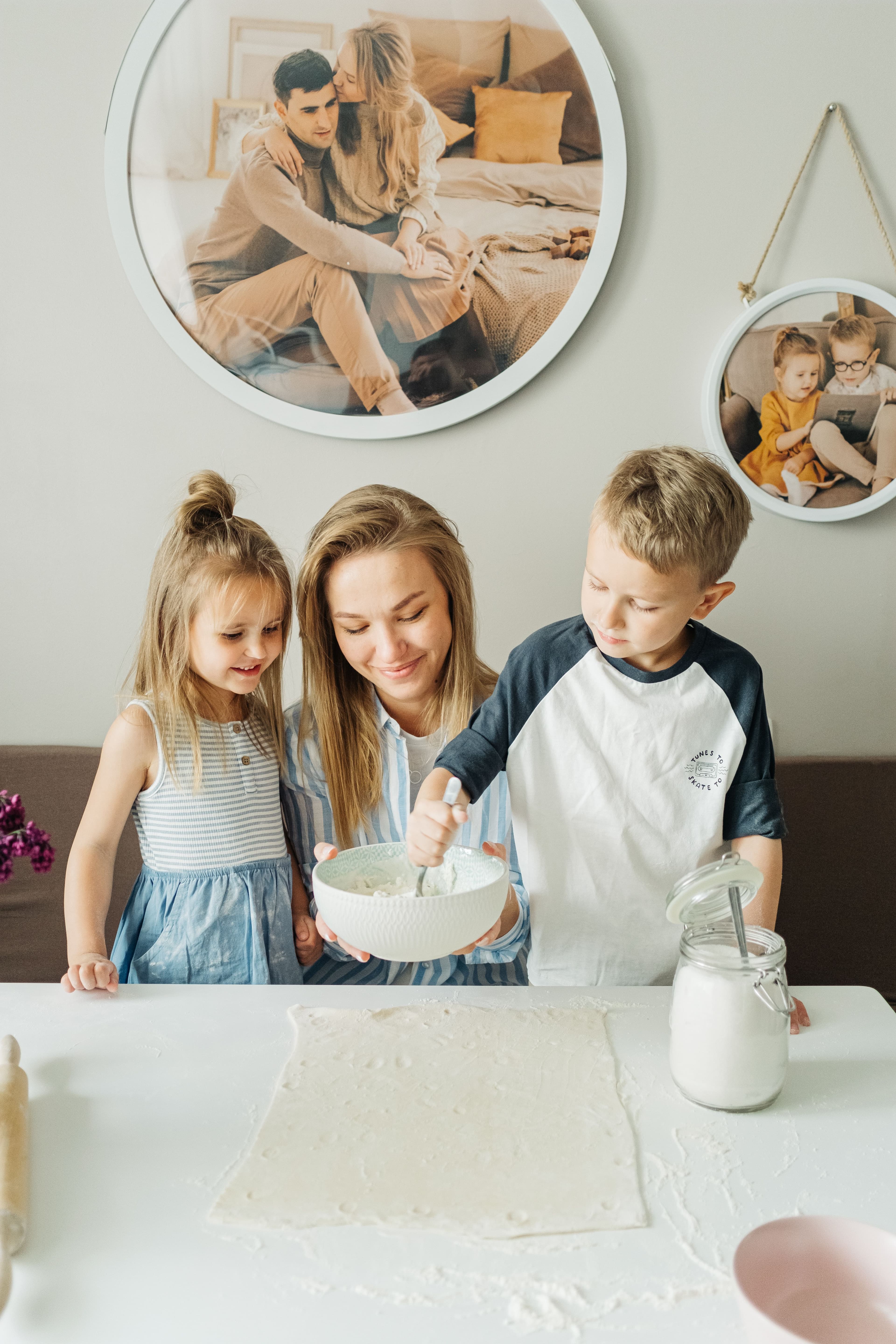
The relational benefits of father-child cooking provide a natural bridge to collaborative recipe preservation. When men and children cook together, they are already engaged in a shared activity that lends itself to documentation, such as taking photos of ingredients or recording short videos of techniques.
Narrative preservation guides suggest pairing structured storytelling with the digitization of recipe materials, such as scanning old notes.
Father-child cooking sessions are ideal moments to implement such advice. After cooking, the pair can sit together to write down the recipe, discuss what they liked, and reflect on who in the family might enjoy receiving this documented version.
Seeing their father co-create digital Keepsakes about recipes in a Legacy Room teaches children that preserving memories is a shared responsibility.
MyHeirloom offers several features that can support this collaborative process. The Legacy Room provides a central, organized space where father-child teams can upload photos, text, audio, and video related to specific recipes, while Weaver can assist fathers with prompts to easily structure their memories.
Digital preservation of family recipes: Tools, practices, and pitfalls
From paper cards to digital archives
Traditional methods of preserving family recipes often rely on fragile physical media: handwritten cards, notebook pages, and well-used cookbooks annotated with personal notes. Archival experts warn that such materials are highly vulnerable to damage from liquids, grease, and environmental exposure.
Scanning and digitization are widely endorsed as effective strategies to secure the content of recipes while keeping the physical originals in safe storage.
High-resolution scans can capture the unique visual character of recipe cards, including handwriting and personal annotations. However, this transition from physical to digital storage introduces new challenges, as files may become scattered across devices and cloud services without cohesive organization.
Recording personal memories related to each dish ensures that both procedural steps and rich emotional context are preserved for future generations.
The rise of specialized recipe-preservation apps
In response to the limitations of generic file storage, a number of specialized mobile apps have emerged to support recipe digitization and organization. Some applications focus explicitly on family recipes, providing private spaces where users can store recipes alongside voice stories, photos, and recollections.
Other apps concentrate on technologically assisted digitization, offering AI tools that can convert photos of handwritten recipe cards into structured digital entries.
Despite their usefulness, many of these apps focus primarily on ingredients, instructions, and photos, with limited support for deeper storytelling or relationship mapping. They may excel at turning paper recipes into searchable digital entries but provide less structure for knitting those entries into a broader family narrative.
MyHeirloom as a legacy-oriented alternative
MyHeirloom’s architecture situates recipes within a wider ecosystem of personal and family legacy features, including Keepsakes, My Tribe, Family Tree, Life Timeline, and the Family Cookbook. Unlike single-purpose recipe apps that focus solely on culinary data, MyHeirloom treats recipes as one category of meaningful content among many.
Keepsakes can link each recipe to photos of gatherings, audio recordings of techniques, or video clips of a grilling session.
Moreover, MyHeirloom’s Life Timeline feature allows dated recipes to be visualized chronologically, illustrating how culinary practices evolve over a lifetime. My Tribe can store profiles of the people connected to each recipe, while the Family Tree situates those relationships within genealogical and chosen-family structures.
The platform employs encryption and clear visibility settings to help users manage access to their content in a highly reliable, private environment.
Men, memory, and digital legacy: Barriers and opportunities
Psychological and cultural barriers for men
Despite the potential of grilling and smoking to serve as gateways, many men face psychological and cultural barriers when it comes to memory preservation. Gender norms that portray emotional reflection as feminine can lead men to focus primarily on practical aspects of cooking—technique, equipment, timing—while avoiding narrative dimensions.
Additionally, men who grew up in households where women handled both cooking and documentation may internalize the idea that preserving recipes is not their responsibility.
Give them the home they deserve. Bring your family legacy into the digital age.
Start archivingCultural scripts around grilling further complicate matters, as pitmaster identities are often framed as highly performance-oriented. Legacy-oriented activities may not be explicitly valued within these scripts, and some men might worry that documenting their evolving methods will clash with the image of expertise they wish to project.
Opportunities in reframing legacy work
Overcoming these barriers requires reframing legacy work as an extension of craftsmanship rather than as domestic labor. For pitmasters, recipe preservation can be presented as professionalizing their craft, allowing men to maintain their own barbecue portfolio of recipes, stories, and family memories inside a personal Legacy Room.
When men understand that documenting recipes together with children can strengthen those bonds, they may feel more inspired to engage.
Technology design can help by reducing cognitive load and offering gentle guidance. Platforms like MyHeirloom incorporate tools such as Weaver, an AI-based guide for storytelling and reflection, which can prompt users with questions and help structure narratives without requiring them to be skilled writers.
The role of MyHeirloom in engaging men in recipe preservation
MyHeirloom’s Legacy Room as a structured space for male participation
MyHeirloom’s Legacy Room offers an organized, privacy-first environment where individuals can curate their life stories and recipes in a unified structure. For men who might otherwise see their grilling photos and notes dispersed across devices, the Legacy Room provides a concrete destination for consolidating this material into coherent Keepsakes.
Men can specify ingredients, steps, and variations, while linking these entries to Keepsakes that capture the particular occasions when the recipes were enjoyed.
My Tribe and the Family Tree extend this context by mapping relationships, showing how culinary knowledge moves across lines of kinship, mentorship, and friendship. The Life Timeline connects recipes to specific dates, enabling users to visualize their culinary journey across decades of cooking.
Privacy, trusteeship, and long-term continuity
Given that legacy work inherently involves long-term preservation, MyHeirloom integrates features that address the continuity of accounts beyond a user’s lifetime. Trusteeship allows users to designate trusted individuals—often spouses or children—who can assume responsibility for the Legacy Room after the user's passing has been verified.
Patron accounts enable users to construct Legacy Rooms for others, such as compiling recipes, stories, and photos about a grandfather’s barbecue tradition.
By combining these features, MyHeirloom creates a comprehensive infrastructure for digital legacy, of which recipe preservation is a key component. Men can see that their barbecue knowledge and family stories are not merely ephemeral hobbies but part of an integrated, secure legacy for future generations.
Practical strategies for involving men in preserving family recipes
Leveraging grilling and smoking as entry points
One of the most effective strategies for engaging men in recipe preservation is to start with the culinary domains where they already feel confident and invested. Families can invite men to formalize their signature recipes by asking them to articulate ingredients, methods, and tips in more detail than usual.
While the cooking is underway, relatives can ask open-ended questions about how the recipe was developed, capturing actual voice and stories.
After the cooking session, the recorded material can be transcribed or summarized into a short narrative and combined with photos of the grill setup and the final dish. This multi-layered documentation can then be imported into MyHeirloom, where a Keepsake and Family Cookbook entry are created.
Encouraging collaborative father-child recipe projects
Another strategy involves framing recipe preservation as a father-child project, drawing on evidence that cooking together strengthens attachment and improves interaction quality. A father might propose that he and his child create a digital cookbook inside MyHeirloom, focusing on the recipes they cook together.
The father can introduce concepts of legacy, explaining why it matters to record where the recipe came from and who might use it in the future.
MyHeirloom’s design lends itself to these collaborative workflows. Children can be represented in My Tribe as co-creators of particular Keepsakes, and father-child cooking sessions can be added to the Life Timeline, gradually integrating men into the cultural work of recipe preservation.
Integrating men’s stories into family narratives
For many families, existing narrative archives may be dominated by women’s voices and contributions. A deliberate strategy to include men involves identifying culinary domains where male ancestors played significant roles and then seeking out stories and documentation related to those domains.
Once stories are gathered, families can create MyHeirloom Keepsakes that explicitly highlight these men’s contributions, helping re-balance the representation of genders in family narratives.
For men who are no longer alive, Patron accounts or memorial Keepsakes can be used to collate existing materials. Family members can pool memories and recipe fragments to reconstruct an ancestor’s culinary repertoire, ensuring that male contributions are not lost entirely.
Ethical, privacy, and emotional considerations
Avoiding exploitation of sensitive topics
Engaging men in recipe preservation, particularly when it touches on legacy and mortality, requires careful emotional handling. It is important to avoid fear-driven messaging that pressures men to document recipes before it is too late, and instead focus on connection and shared enjoyment.
Similarly, discussions of death, inheritance, and posthumous continuity should be handled sensitively. Platforms like MyHeirloom include features such as Trusteeship and DocuVault to address what happens after a user’s passing, but these tools are meant to empower users and complement formal estate planning rather than replace legal processes.
Privacy and control in digital legacy work
Men who are accustomed to sharing barbecue photos on public social platforms may need to shift their mindset when it comes to legacy content, which often includes more intimate material. Privacy-first platforms like MyHeirloom allow users to manage visibility settings for each piece of content, deciding whether a recipe or Keepsake is private, shared, or public.
This granular control helps men feel comfortable uploading personal stories, knowing they are not automatically exposed to a broad audience.
An additional ethical consideration involves consent and representation. When men document recipes that involve other people, they should be encouraged to seek consent before sharing identifiable photos or stories, especially if content might be made public, thereby respecting the preferences of those involved.
From grills to Legacy Rooms—a new path for men in culinary heritage
Preserving family recipes is far more than an exercise in culinary archiving; it is a way of safeguarding cultural memory, strengthening relationships, and creating tangible bridges between generations. Research on domestic foodwork reveals that women carry a disproportionate share of everyday cooking, which has historically made them the primary custodians of family culinary knowledge.
By recognizing grilling and smoking as gateways to deeper male involvement in recipe preservation, families and platforms like MyHeirloom can begin to rebalance this dynamic. Encouraging men to document their signature recipes and collaborate with children transforms barbecue practice from a series of temporary performances into an ongoing legacy project.
Digital tools have evolved to support this work, but generic recipe apps often lack the broader legacy framing that situates recipes within life stories and relationships. MyHeirloom addresses this gap by offering a Legacy Room where Keepsakes, My Tribe, Family Tree, Family Cookbook, Life Timeline, and DocuVault converge.
As men begin to use MyHeirloom to store their recipes, stories, and instructions, they help turn scattered memories into an organized, secure, and meaningful legacy. Their barbecue rubs and smoking schedules become accessible to future generations, who can not only reproduce the dishes but also hear the voices and understand the contexts that shaped them.
If you are ready to begin capturing your family's unique culinary traditions, start building your Legacy Room on MyHeirloom today. It is a simple, private way to organize your memories, family recipes, and stories in one safe place for the generations to come.
FAQ
1. Is a generic cloud storage folder enough for preserving family recipes?
A cloud folder can store files, but it does not preserve the stories, memories, or relationships behind them. A structured legacy platform like MyHeirloom turns scattered recipe files and photos into contextual family Keepsakes.
2. Can MyHeirloom replace formal estate planning for my family?
No. While MyHeirloom helps organize important memories, documents, and wishes in one secure place like DocuVault, it is not a replacement for professional legal services, formal wills, or binding estate documents.

MyHeirloom gives you a dedicated Legacy Room—a private, secure space to collect photos, videos, documents, and stories.
Start now for free